
The Mind Has Two Speeds, and Both Make Mistakes
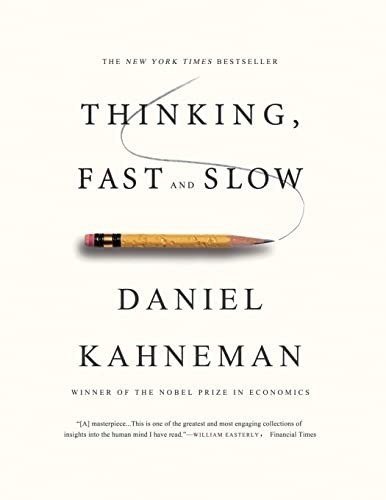
I recently finished reading Thinking, Fast and Slow by Daniel Kahneman. It is a long book, and an unusually generous one, drawing on decades of research, much of it carried out with his late collaborator Amos Tversky.
Kahneman organizes the mind into two modes. System 1 is fast, automatic, and intuitive. System 2 is slow, deliberate, and effortful. Most of what we do is run by the first, and we mistake it for the second.
Here are the lessons that stayed with me.
1. Intuition Is Powerful, and Fallible
Fast thinking is what lets us read a face, drive a familiar road, or finish a sentence. It is also where biases live. The book’s central lesson is that confidence is not evidence of accuracy.
2. Shortcuts Have Predictable Errors
Kahneman describes a set of heuristics that serve us well and mislead us in predictable ways. Anchoring, where an initial number pulls our estimate toward it. Availability, where what comes easily to mind seems more likely. Representativeness, where we judge by resemblance instead of base rates.
Knowing the names of these errors does not make us immune, but it does make them easier to catch in others, and occasionally in ourselves.
3. What You See Is All There Is
One of the most useful ideas in the book is that the mind builds a coherent story out of whatever information is available, without asking what is missing. A confident story, built on limited evidence, feels the same as a well-supported one.
4. Losses Hurt More Than Gains Please
Prospect theory, the work that earned Kahneman the Nobel Prize in Economics, shows that people feel losses more sharply than equivalent gains. It helps explain why we hold on to failing plans and why framing a choice differently can change what we choose.
5. Two Selves, One Life
The book also distinguishes between the experiencing self, who lives through moments, and the remembering self, who keeps the score. They do not always agree, and our memories are shaped disproportionately by peaks and endings.
Why This Matters Beyond Psychology
Judges, doctors, managers, teachers, and policy-makers all make decisions under uncertainty. The planning fallacy, overconfidence, and hindsight bias appear in all of them.
The practical response Kahneman offers is modest. Slow down on high-stakes decisions, seek out information that disagrees with you, and build processes that do not rely on a single confident mind.
Final Reflection
This book left me less certain of my own certainty, which I think is the point. It is a reminder that the feeling of being right is a feeling, not a fact.
Humility, it turns out, is not just a virtue. It is a method.
Keep Reading
Atomic Habits: Key Lessons and Reflections
Big change rarely arrives as one dramatic moment. In Atomic Habits, James Clear argues that it is built from tiny daily decisions that compound over time. In this reflection, I share the ideas that stayed with me and why they matter far beyond personal productivity.
Self Leadership and the One Minute Manager: Key Lessons and Reflections
Leadership begins long before titles, promotions, or authority. Self Leadership and the One Minute Manager is a reminder that the quality of our work, relationships, and personal growth depends first on how well we lead ourselves. In this reflection, I share the lessons that resonated with me most and why they matter far beyond the workplace.
Set Boundaries, Find Peace
Nedra Glover Tawwab's practical case for boundaries as the foundation of healthy relationships — not walls, but clarity.
Comments
No comments yet — be the first to share your thoughts.