
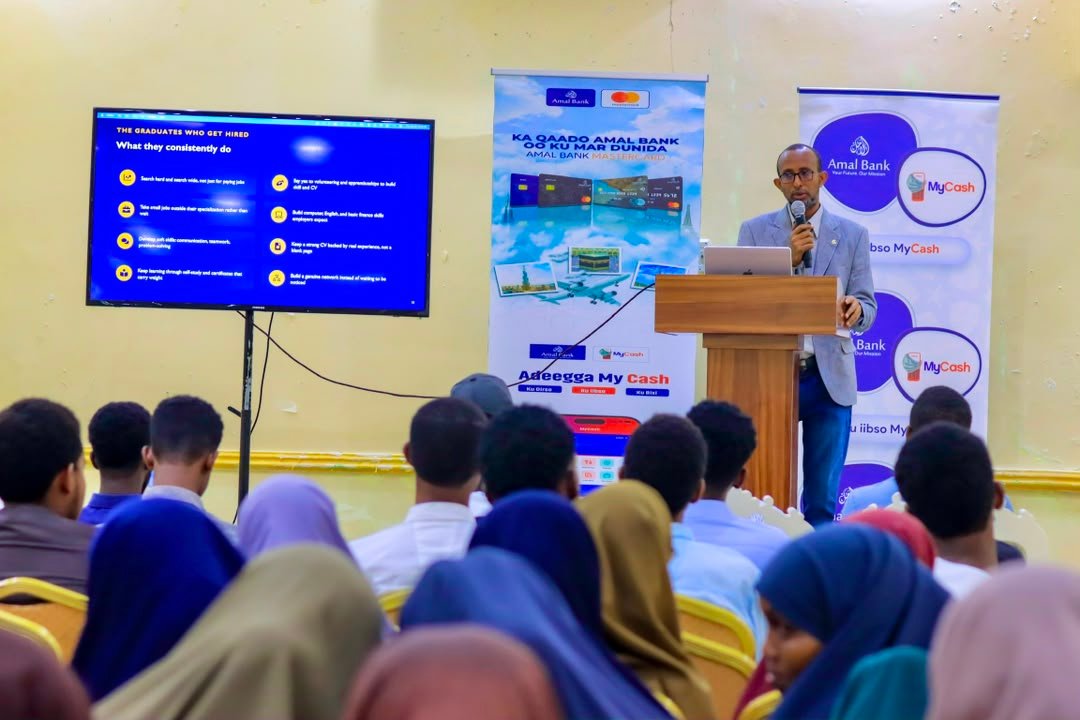
I stood in front of a room of graduates yesterday and told them something they probably didn't want to hear: their degree is not the hard part anymore. Finishing it was. What comes next is harder, and almost nobody prepared them for it.
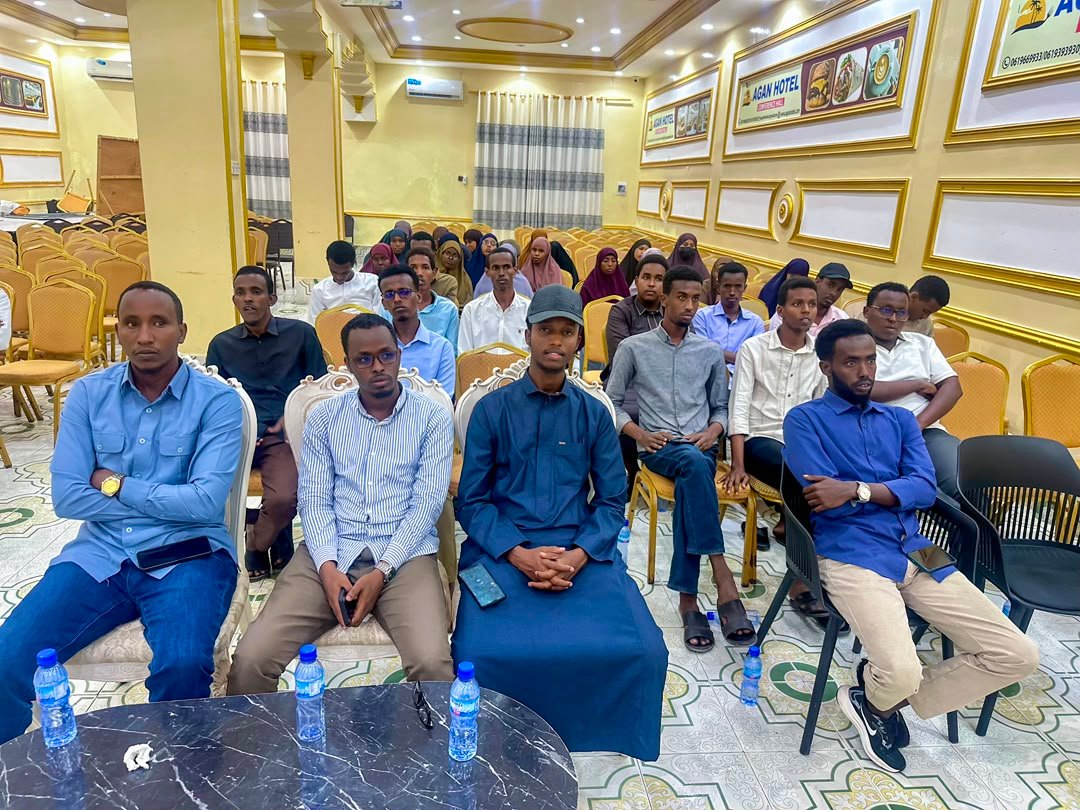
We ran the session from 4:30 to 6:30 at Agan Hotel, and it happened at all because Amal Bank's Kismayo branch stepped in to facilitate and sponsor the gathering. That mattered more than a line item on a program. It meant a private sector employer was in the room, not just as a sponsor logo, but as a participant in the exact conversation I was having with graduates about who actually hires in this city.
I've been circling this topic for a while, mostly because I keep meeting bright, capable young people in Kismayo who did everything school asked of them and still can't find work. That's not a motivation problem. It's a mismatch between what they were trained to do and what the market actually pays for right now, and this year that mismatch is worse than usual.
The timing problem nobody chose
This graduating class didn't pick a bad year on purpose, but they got one anyway. Cuts to US and international relief support have pulled money out of an economy that runs heavily on aid-linked spending, and that money doesn't come back quickly. War in the Middle East has raised shipping costs and disrupted trade routes that Somalia's private, informal sector leans on to move goods. On top of that, a contested election and a slow federal transition have stalled public hiring, and the ongoing disconnect between the Federal Government and and federal member states keeps stalling joint projects that would otherwise create jobs.
I said all this out loud in the room, partly because graduates deserve honesty and partly because I wanted them to stop blaming themselves for a market they didn't build. But I also didn't want anyone walking out feeling like a victim of circumstances, because the second half of the talk was about what's actually still in their hands.
Two doors, when there are four
Here's the part I pushed hardest on. In Kismayo and elsewhere in Somalia, tradition points graduates toward two doors: start a business, or get hired. Both are completely legitimate goals. Neither one is a shortcut.
Entrepreneurship needs capital. Not only a good idea or business plan, but also capital. And most new graduates don't have it yet. Employment needs job-ready skills, and a transcript doesn't prove you have those. It proves you can pass an exam. Employers want to know if you can write a report, run a spreadsheet, talk to a client, or fix a problem nobody walked you through step by step.
What almost nobody in that room had considered seriously were the other two doors: internships and volunteering. I watched a few faces change when I said this out loud, that unpaid work is not a consolation prize. It's how you build a CV before you have a job to put on it. It's how you get references, learn how a real workplace runs, and prove you show up when it counts.
A demonstration nobody planned
That last point ended up getting proven in real time, which is more than I could have asked for. Amal Bank had built an interval into the session where their team shared a bit about how the bank actually operates as a private institution and what that has to do with graduates specifically, then ran a quiz on the bank's services with small cash prizes for the winners. It was lively, the room woke up a little, and it gave the graduates a direct look at what a private employer actually wants them to know.
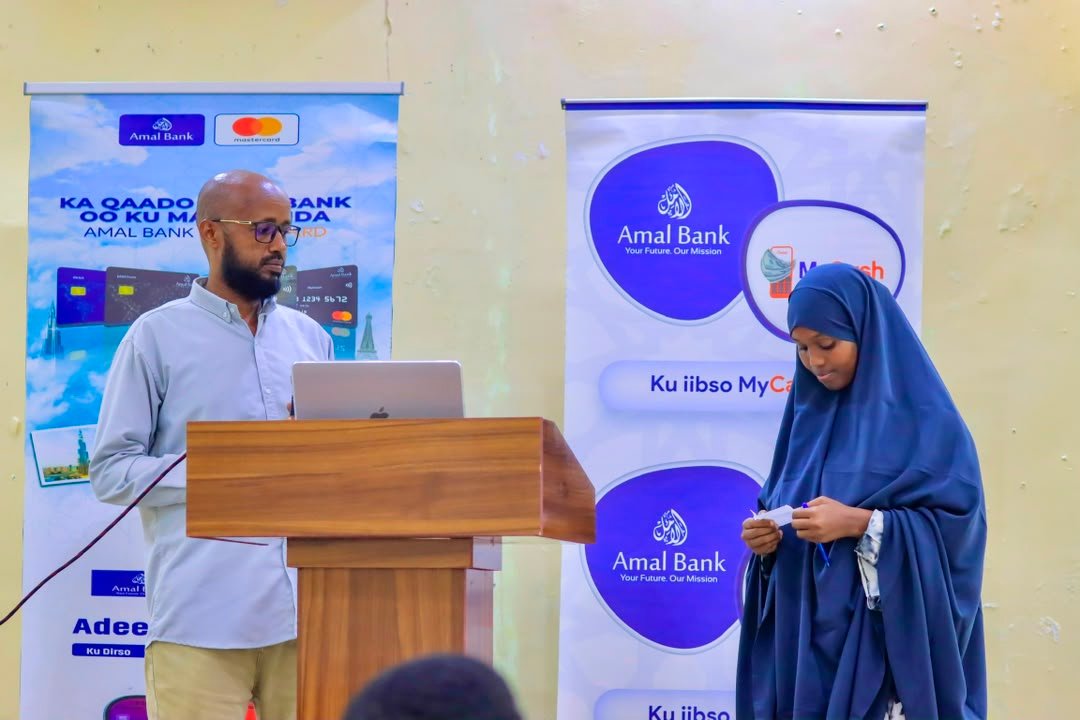
Then the bank's marketing department chief took the floor for a moment and connected it straight back to what I'd just spent half an hour arguing. He said the point about internships and volunteering was exactly right, and to prove it, he offered two graduates in the room an on-the-spot chance to apply for an internship at the bank. I couldn't have staged a better illustration of my own argument if I'd tried. A room full of graduates just watched an opportunity appear for two of their peers, for showing up and paying attention, not for having connections or capital.
The list that made a few people uncomfortable
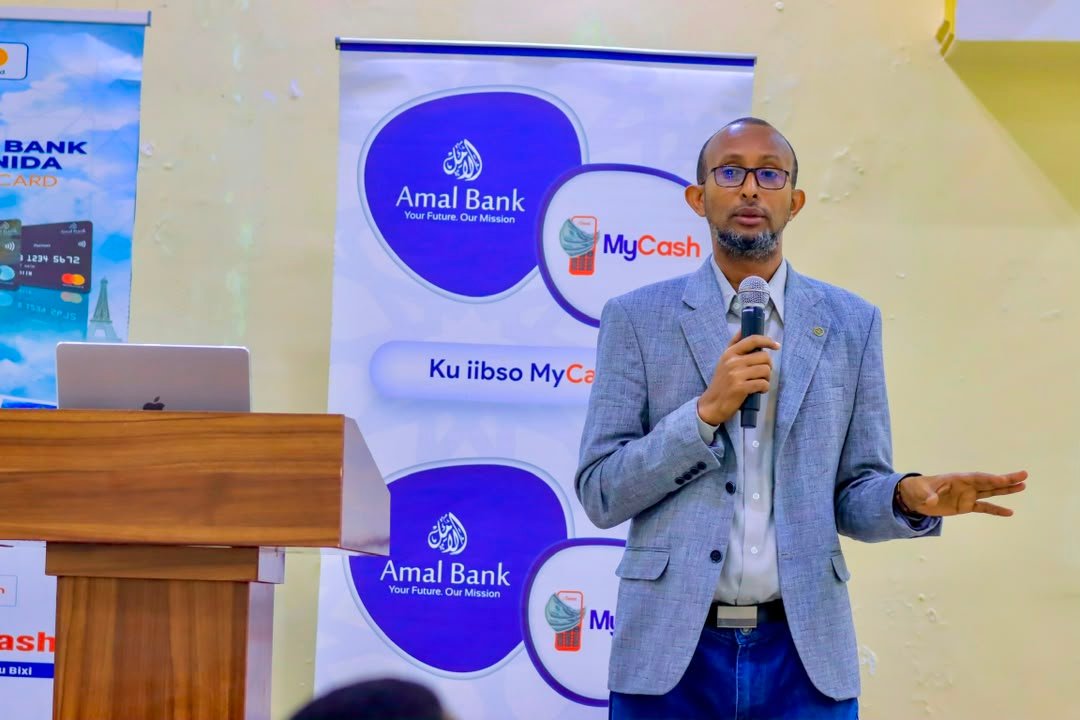
I put up two lists that afternoon. One was everything that separates graduates who get hired from graduates who don't: a wide job search instead of a narrow one, willingness to volunteer, computer and English skills, a CV with actual experience on it, and the habit of learning something new on their own time. The other list was the opposite: an empty CV, weak English, no network, no self-study, and a quiet comfort with staying home.
Some of what separates people is genuinely unfair. Family wealth, an existing family business, connections, plain luck. I didn't pretend otherwise. But I told them the honest thing too: most of what actually gets you hired isn't luck. It's buildable, starting now, with whatever resources you already have.
The question I left them with
Near the end, I asked the room three questions and told them to sit with the discomfort instead of rushing past it. If you were hired tomorrow, what could you actually add to that organization? What makes you more valuable than the candidate standing next to you? Which job or field do you genuinely see yourself in, and what's the next step to get there? Nobody answered out loud. That was fine. Those questions weren't for the room, they were for the walk home.
What stayed with me afterward
Honestly, the energy in that room by the end was more than I expected. Graduates stayed past the closing, and a good number of them told me directly they were going to act on this, starting with the internship and volunteer piece, this week and not someday. That kind of reaction from a room of people who'd just spent two hours hearing about a difficult job market tells me the message landed the way I hoped it would.
A degree tells an employer you can finish something long and difficult. That's worth something, but it's not the same as being valuable to hire. The bridge between the two is built out of ordinary things: a skill you practiced on purpose, a volunteer shift you didn't get paid for, a small job you didn't think was beneath you, a certificate tied to something you can actually do. Amal Bank just showed a room full of graduates what that bridge looks like when someone actually extends it.
None of it requires connections you don't have or capital you haven't raised yet. It requires starting, this week, with the CV you can build today instead of the one you're waiting for someday to hand you.
Nobody is coming to hand you a career. You build it, one honest skill, one small yes, and one bold application at a time.
Keep Reading
Higher Education Outcomes in Somalia: A Dead End or a Warning That Demands Attention?
Somalia's higher education system has made remarkable progress, but it now stands at a critical crossroads. Families invest scarce resources in university education, and institutions produce thousands of graduates each year. Yet unreliable labour-market information, programmes disconnected from national workforce needs, and recruitment shaped by personal networks leave many graduates unemployed and dependent on their families. The central question, therefore, is not simply how many universities Somalia has or how many students graduate each year, it is where Somali graduates go after leaving university.
In the Midst of the Chaos, There Is a Lesson to Be Learned — The Somali Paradox
What looks like chaos from the outside may contain a system of its own. In Somalia, people have repeatedly built practical solutions where formal institutions were absent or unable to respond, from hawala and mobile money to telecommunications, livestock networks, xeer, and education. These are not simply stories of survival. They are stories of adaptation, trust, ingenuity, and collective action. Perhaps the real lesson is this: sometimes the system does not come first. People begin solving the problem, and the system grows around what works.
Problem Solving for Teachers: Notes from a Workshop at Alnor Academy
I ran a problem-solving workshop for Alnor Academy's teaching staff, and the room gave me as much as I gave it. What started as a session on symptoms, causes, and shūrā turned into an unscripted debate about AI in homework — and why a school needs a real policy, not each teacher improvising alone.
Comments
Good job 👏