
Ask almost anyone in Somalia whether our education is in trouble and they will say yes. Ask them why, and the answers scatter: no money, no government, untrained teachers, unmotivated students, too many universities. Each answer holds some truth. But when I place them side by side, they point to something more specific than a “broken system.”
I have worked in education for more than 20 years, first as a school teacher, then as a university lecturer and faculty dean. What I describe here is not a research finding. It is a pattern I keep seeing from the inside, and I have given it a name so we can talk about it clearly. I call it the 3C Cycle.
The graduate we keep meeting
Start with the end of the story. Every year, schools and universities send out thousands of young people with certificates in their hands. Many of them are bright and hardworking. But too many hold a paper that says more than they can do. They know the theory but cannot solve a problem. They have the degree but not the skills of the profession. When the textbook runs out, so does their thinking. I call this the hollow graduate: a certificate without competence.
The hollow graduate is not the young person’s failure. It is the product of a system, and three gaps sit at the root of it.
Three gaps at the root
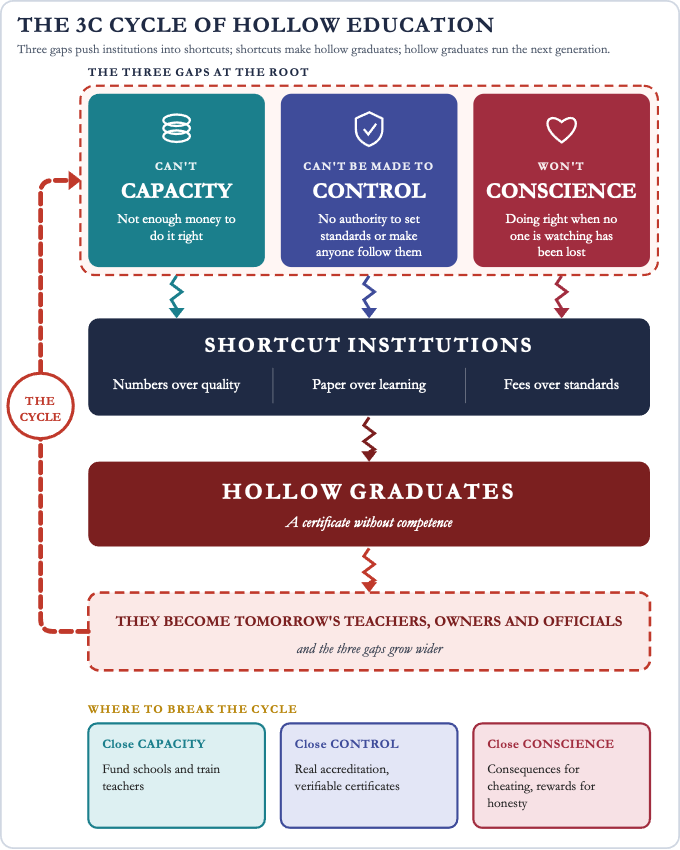
Figure: the 3C Cycle.
Gap 1: Capacity. Institutions cannot do it right, because they do not have the means. Most schools and universities in Somalia are privately established and privately owned. Few have a steady budget. They live on student fees and on what parents can pay out of pocket. Doing education well costs money: trained teachers, materials, small classes. When the money is never enough, something gives, and what gives is quality. Institutions grow their numbers instead, because more students means more income. There is also a deeper tension. An institution that is a business must earn, and serving the public interest of the Somali people is hard when salaries depend on fees.
Gap 2: Control. Institutions cannot be made to do it right. Many were born in the middle of the civil war, when there was no government to license them or set a standard. Thirty years later, a generation has grown up where people reached their goals through their own shortcuts, and asking them to take the formal road is hard even when the government tries. Requirements exist on paper but are waived for whoever applies. There are no real prerequisites. And without a clear standard, nobody can say what “substandard” means.
Gap 3: Conscience. This is the hardest gap to talk about. When money is short and rules are weak, the last protection for quality is the integrity of the people running and working in these institutions: doing what is right and required, no matter what, even when no one is watching. Too often that protection has worn thin. I do not say this to blame individuals. People respond to the pressures around them, and an owner who knows a failing student’s family will pay next term’s fees faces a real temptation. But the results are the same everywhere: students are promoted who should not be, certificates are earned without attending class, and national exams are cheated on in the open.
I think of the three gaps as one chain of questions. Capacity asks: can we do it right? Control asks: can anyone make us? Conscience asks: will we do it anyway? In Somalia today, the honest answer to all three is: not reliably.
From gaps to shortcuts
Together the gaps push institutions toward the same choices: numbers over quality, paper over learning, fees over standards. These are rarely dramatic acts of corruption. They are small, daily compromises. A teacher who was never trained to teach holds the job because it was the only one available; a business graduate who lost his job ends up teaching science. A curriculum has no clear learning outcomes. A student who is unmotivated and learns little is promoted anyway, because the school depends on that student’s fee. Each choice is understandable. Together they make a system of shortcuts.
Why it becomes a cycle
This is what turns a list of problems into a cycle. The hollow graduate does not disappear. Some become teachers, because teaching is the job available. Some open schools and universities, because education is a business with steady demand. Some join the ministries and agencies that are supposed to regulate education. Each carries into the next generation the habits of the system that made them. The gaps grow wider, and the next batch of graduates is hollower still.
It also explains why single fixes keep failing. Money alone does not help if no one is checking how it is used. Rules alone do not help if institutions cannot afford to follow them. Sermons about ethics do not help when the system rewards shortcuts. Each treats one gap while the other two pull the system back.
Breaking the cycle
If the problem is three gaps in a loop, the answer is to close all three together.
Close capacity. Fund schools properly and train the teachers we already have, before adding more institutions.
Close control. Build real accreditation, and make certificates verifiable, so a diploma means the same thing wherever it was issued.
Close conscience. Attach consequences to cheating and reward the institutions and people who do the right thing when it is hard.
None of this is quick. But a problem with a name can be discussed, measured and argued over, and I believe naming the cycle is the first step.
Over to you
I offer the 3C Cycle as a lens, not a final truth. If you are a teacher, parent, student, school owner or official, I would like to hear where it fits your experience and where it does not.
Keep Reading
Higher Education Outcomes in Somalia: A Dead End or a Warning That Demands Attention?
Somalia's higher education system has made remarkable progress, but it now stands at a critical crossroads. Families invest scarce resources in university education, and institutions produce thousands of graduates each year. Yet unreliable labour-market information, programmes disconnected from national workforce needs, and recruitment shaped by personal networks leave many graduates unemployed and dependent on their families. The central question, therefore, is not simply how many universities Somalia has or how many students graduate each year, it is where Somali graduates go after leaving university.
In the Midst of the Chaos, There Is a Lesson to Be Learned — The Somali Paradox
What looks like chaos from the outside may contain a system of its own. In Somalia, people have repeatedly built practical solutions where formal institutions were absent or unable to respond, from hawala and mobile money to telecommunications, livestock networks, xeer, and education. These are not simply stories of survival. They are stories of adaptation, trust, ingenuity, and collective action. Perhaps the real lesson is this: sometimes the system does not come first. People begin solving the problem, and the system grows around what works.
Problem Solving for Teachers: Notes from a Workshop at Alnor Academy
I ran a problem-solving workshop for Alnor Academy's teaching staff, and the room gave me as much as I gave it. What started as a session on symptoms, causes, and shūrā turned into an unscripted debate about AI in homework — and why a school needs a real policy, not each teacher improvising alone.
Comments
No comments yet — be the first to share your thoughts.