
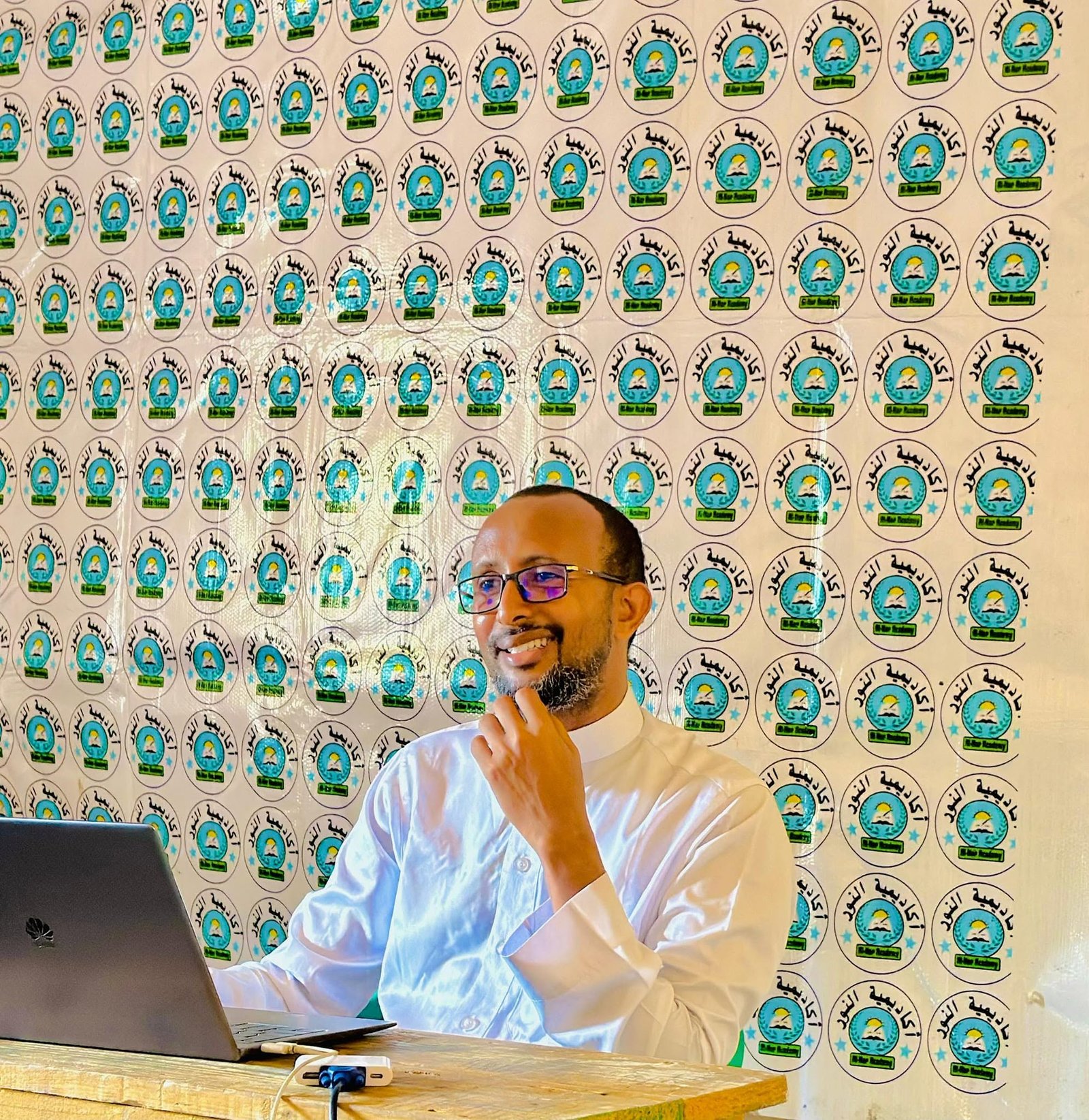
I recently ran a workshop for the teaching staff at Alnor Academy on problem solving, and I wanted to write down what happened while it's still fresh — because honestly, the room gave me as much as I gave them.
Alnor Academy teaches primary education and Islamic studies woven together

Where I started
I opened with a question that has nothing to do with schools: is problem solving even a human thing, or do animals do it too? A monkey uses a stick to reach fruit. An ant links up with others to build a living bridge. If problem solving just means closing the gap between what is and what's wanted, we didn't invent it — it's one of the oldest habits of life. What's distinctly human is that we can imagine a solution before it exists and hand it to someone who never faced the problem themselves.
That set up the point I kept returning to: teaching itself is daily problem solving. A late student, a noisy class, a worried parent, a tired teacher — these aren't interruptions to the work. They are the work, and most people in that room had already solved several small problems before the session even began.
The core idea
The center of the talk was simple: a problem is the gap between the current situation and the desired one — and you describe the gap, not the person. "Only 35% of students submit homework" can be investigated. "Students are lazy" is a dead end.
From there we looked at where problems actually come from (students, classroom, people, workload), and the difference between symptoms and causes — a student sleeping in class could be laziness, or illness, hunger, fear, or something happening at home. Punishing the symptom can deepen the cause. I compared it to a doctor: you examine before you prescribe. We practiced separating facts from assumptions, used the Five Whys to chase a symptom to its root, and used a simple impact-versus-effort matrix to choose which fix to act on first.
One slide that really landed was about staying calm before responding — pause, breathe, name it, listen, then solve — tied to shūrā (consultation), referencing the verse in Surah Aal-'Imran on consulting others. Alongside it: patience, justice, mercy, and trust as the values that shape not just what we decide, but how we get there.
Where it got interactive
This was the best part. Instead of me running through case studies, I opened the floor and asked teachers to bring their own real problems into the room — and they did. Some were familiar: repeated lateness, an upset parent, two colleagues sending mixed disciplinary messages.

But one topic took over the discussion for a while: AI use in homework — students using it directly, and in some cases parents handing over their own phones so their kids could access it at home. That's not a classroom-management problem, it's a policy gap. My honest answer was that this can't be left to individual teachers to improvise lesson by lesson. AI can genuinely assist learning, but only if the school decides deliberately how that should look. I suggested Alnor Academy needs a clear, written AI policy, communicated to parents, instead of everyone making their own call and homework quietly stopping meaning what it's supposed to mean.
That one conversation alone justified making the session interactive. A slide can't anticipate a problem that didn't exist two years ago. A room full of people living it every day can.
How it ended
We closed on this: problems aren't proof a school is failing. Every healthy school has them. The real measure is how wisely, fairly, and consistently the staff respond — understand, consult, act, review. Each teacher committed to one real problem and one small next step before the following week.
The discussion ran long, in a good way, and the feedback afterward was warm — people said it felt less like a training and more like a conversation they'd needed to have with each other for a while. The most valuable part of the day wasn't anything on my slides. It was watching a staff room realize they already know how to do this — they just needed the shared language to do it more deliberately, together.
Keep Reading
Higher Education Outcomes in Somalia: A Dead End or a Warning That Demands Attention?
Somalia's higher education system has made remarkable progress, but it now stands at a critical crossroads. Families invest scarce resources in university education, and institutions produce thousands of graduates each year. Yet unreliable labour-market information, programmes disconnected from national workforce needs, and recruitment shaped by personal networks leave many graduates unemployed and dependent on their families. The central question, therefore, is not simply how many universities Somalia has or how many students graduate each year, it is where Somali graduates go after leaving university.
In the Midst of the Chaos, There Is a Lesson to Be Learned — The Somali Paradox
What looks like chaos from the outside may contain a system of its own. In Somalia, people have repeatedly built practical solutions where formal institutions were absent or unable to respond, from hawala and mobile money to telecommunications, livestock networks, xeer, and education. These are not simply stories of survival. They are stories of adaptation, trust, ingenuity, and collective action. Perhaps the real lesson is this: sometimes the system does not come first. People begin solving the problem, and the system grows around what works.
What I Told Kismayo's Graduates about Current Employability Prospects
Notes from a lecture I gave to Kismayo's newest graduates at Agan Hotel: a degree isn't the hard part anymore, and almost nobody prepares you for what comes after it. Two doors get all the attention — start a business, or get hired — but two more, internships and volunteering, quietly build the CV that makes either one possible.
Comments
May Allah reward you for your honest deeds. Very nice article, sure l feel in my reading the article that lam in the glass.